2 June 2025
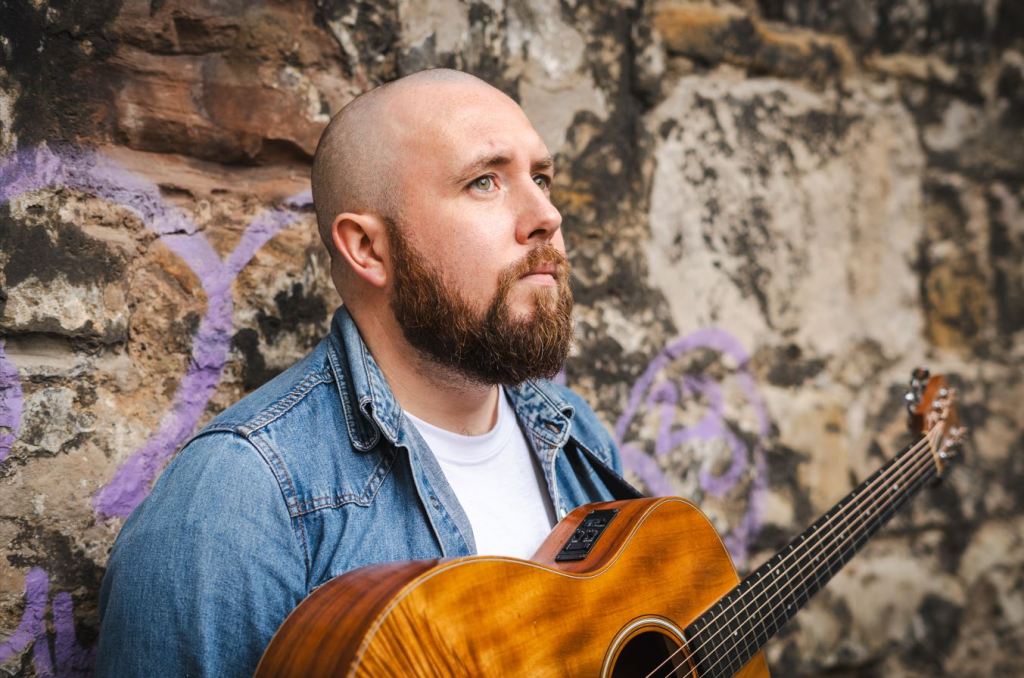
Every Monday I will be bringing you an interview with an independent band, duo or music artist. This week, I caught up with Edinburgh based artist Stephen McCafferty to find out more…
Where are you from and how did you first get into music?
I’m originally from Leslie in Fife, but I’m now based in Edinburgh. I moved around a fair bit during my mid to late teens, mostly up and down the east coast of Scotland, before landing in Edinburgh when I was 22.
Some of my earliest memories involve dancing around my room to records and cassette tapes. I grew up listening to a lot of my mum’s old compilation tapes that had lost their sleeves, so half the time I had no idea who or what I was listening to. It’s strange to think how difficult it used to be to track down a song, I remember spending years trying to find Living on My Own by Freddie Mercury, going through the entire Queen back catalogue before eventually realising it was a solo track. Years later, I stumbled across it again on a blank CD in a mate’s car, that feeling of rediscovery is something I kind of miss now that everything’s instantly accessible.
The only record I remember owning that I could genuinely call my own at the time was the banger 10 Fat Sausages Sizzling in a Pan. A short but iconic era.
I properly got involved with music when I was 10, after moving school and making a friend who wanted to start a band. He told me I could join on one condition: I had to write songs. I wrote my first that same night and haven’t really stopped since.
Who were your musical influences when you were growing up and who are your influences now?
I was a kid in the ’90s, so Britpop was everywhere. I remember my babysitter’s daughter had a poster of Jarvis Cocker on her wall, sticking the V’s up, she was older, cooler, and I think that association lodged somewhere in my brain. I spent hours watching the music video channels and found myself drawn to bands like Pulp, Supergrass, Blur, Radiohead, R.E.M., and Oasis.
Later on, I circled back to my mum’s ’80s music collection, Eurythmics, Deacon Blue, David Bowie, Fleetwood Mac, all of which still carry a lot of nostalgia. My dad, alarmed by a brief Spice Girls phase, tried to course-correct by bringing home a stack of ’60s records, Dylan, The Who, The Animals. It kind of worked: I fell in love with Bob Dylan, but Spice Up Your Life still goes hard.
At primary school, one of the teachers used to wheel out the piano for sing-alongs. A lot of them were Beatles songs, so that was my first introduction to Yesterday, Eleanor Rigby, The Long and Winding Road, and others. I hadn’t grasped how culturally important they were yet, I just knew I liked those songs more than the rest.
How would you describe your sound?
It’s always hard to pin down a sound, I find it easier to talk about lyrical themes, but broadly, I’d describe it as acoustic-led indie rock with a focus on existential ideas and big choruses.
Some tracks lean softer, like Quiet Dream, while others have a more folk-tinged feel, like Reason to Run, but there’s a consistent thread running through them. I like layering vocal harmonies and using different guitar voicings to build texture, the aim is to create something melodic and reflective, with a sense of nostalgia for classic songwriting but shaped through a modern lens.
What is your latest release called and what was the influence behind it?
My latest single is called Rubber Glove, and out of the eight singles I’ve released so far, it leans most into the ’90s sound I grew up with. I think it probably sits somewhere between Manic Street Preachers and Supergrass, although during recording, the engineer I work with said the guitar work reminded him of Blur and Radiohead. My manager hears Lightning Seeds, so it’s definitely rooted in that ’90s world.
There’s humour in it, but also frustration. I wanted it to sound energetic and infectious on the surface, while still carrying something more unsettled underneath.
What’s your local music scene like?
I’m based in Edinburgh, and the music scene here is lively but quite fragmented. There’s definitely a lot of talent, and some great grassroots spaces doing their best to support local acts, but it can feel a little scattered at times, more of a collection of micro-scenes than one unified whole. That said, the audiences are generally up for hearing something new, and I’ve had some great responses.
I think there’s real potential in the Scottish scene as a whole, especially if more support structures can grow around it. The talent’s already here, it’s just about giving it the room to breathe.
What do you have planned for the next 12 months?
I’m continuing with my current release schedule, putting out a new single every eight weeks. Rubber Glove is the eighth since I returned to releasing music, and the rest of the year’s singles are virtually ready to go, just need to be mixed, and I have plans to film some live sessions and possibly a video or two along the way.
On the live front, I’ll be playing more shows across Scotland, including some dates in Glasgow and Edinburgh, and I’m hoping to build towards playing more festivals and support slots further afield. I’m also working behind the scenes on a run of acoustic versions and some physical merch to tie it all together. It’s been a busy year already and I don’t see it slowing down any time soon.
Is there anyone you’d love to collaborate with?
There are plenty of artists I admire, but I’m more interested in collaborating with people whose work feels emotionally or thematically aligned, rather than just chasing a name. James Dean Bradfield, Gaz Coombes, or Lucy Rose would all be fascinating to work with, they each bring something distinct, both lyrically and sonically.
I’d also love to have a wee sing-song with Annie Lennox. Her voice is so tied to my childhood and I remember being equally mesmerised and mildly terrified by the Greatest Hits album cover. I was convinced her eyes followed me around the room.
Closer to home, I’ve started collaborating with Ace & All The Other Animals, a really talented young singer who features briefly on Rubber Glove and will appear more prominently on a couple of upcoming tracks. I’d love to keep building those kinds of collaborative relationships, where the voices naturally complement each other and add something unexpected to the song.
Any funny stories surrounding your live performances?
Well, in the early to mid-2000s, I was in a band called The Debutants, an unremarkable name for an unremarkable group of teenage boys playing unremarkable landfill indie to an unremarkable degree of success. It was the tail-end of a cultural moment where everyone still wanted to be The Libertines, without the inconvenience of talent, charm, or charisma.
We were booked to play an all-day festival in Dunfermline, Scotland’s ancient capital, once home to kings, monks, and now, an out-of-town leisure park with a multiplex cinema. We weren’t on until the evening, so naturally, as devout acolytes of the ’90s “lad” mythology (the kind of thing Loaded magazine tried to sell as an identity), we decided to spend the day drinking in the park. Because that’s what musicians did. You drank warm lager, took yourself far too seriously, and waited for something to happen. Nothing ever did.
Later, we staggered into the venue, already sweat-drenched and helium-light. The barman, mistaking us for professionals, kindly offered us the closed-off upstairs bar to rehearse. Instead, we robbed it. We raided the fridges. We inhaled helium from a 60th birthday balloon arrangement like feral toddlers at a rave. “Happy 60th,” it said. But it wasn’t a happy 60th. It was a deeply confusing one.
When the bar owner came upstairs to collect us for our set, the look on his face, a soup of bewilderment, fury, and quiet sadness, said it all. But for some reason, he still let us play.
We got through two songs. Then the third imploded. A pint glass was thrown. A man with a teardrop tattoo under his left eye, which I think means he’s killed someone, materialised, and with the help of the bouncers, we were all physically removed from the premises, I was carried out horizontally, one man on my arms, one on my legs, like a rolled-up carpet of regret.
We never got asked back. And to be honest, we shouldn’t have been asked in the first place.
Do you have any upcoming live dates and performances?
I just played The Montrose Festival (May 25th), and coming up I’ll be playing HMV Glasgow on Saturday 14th June, Bannerman’s in Edinburgh on Sunday 16th June, and The Poetry Club in Glasgow on Wednesday 26th June.
You can keep up to date with all my gigs by following me on Bands In Town, there’s a link in the gig section of my website.
What is the one thing that you want readers to know about you?
I’m not really trying to sell a lifestyle, a brand, or some overly curated version of myself. I write songs because it helps me make sense of things, and if those songs happen to connect with someone else, even briefly, then that’s enough. I’m not chasing fame or virality, I’m just trying to put something genuine into the world that lasts a little longer than the scroll.
You can find out more about Stephen on his website or via Apple Music, Facebook, Instagram, SoundCloud, Spotify, TikTok, X (Twitter) or YouTube.
 HOME
HOME 